

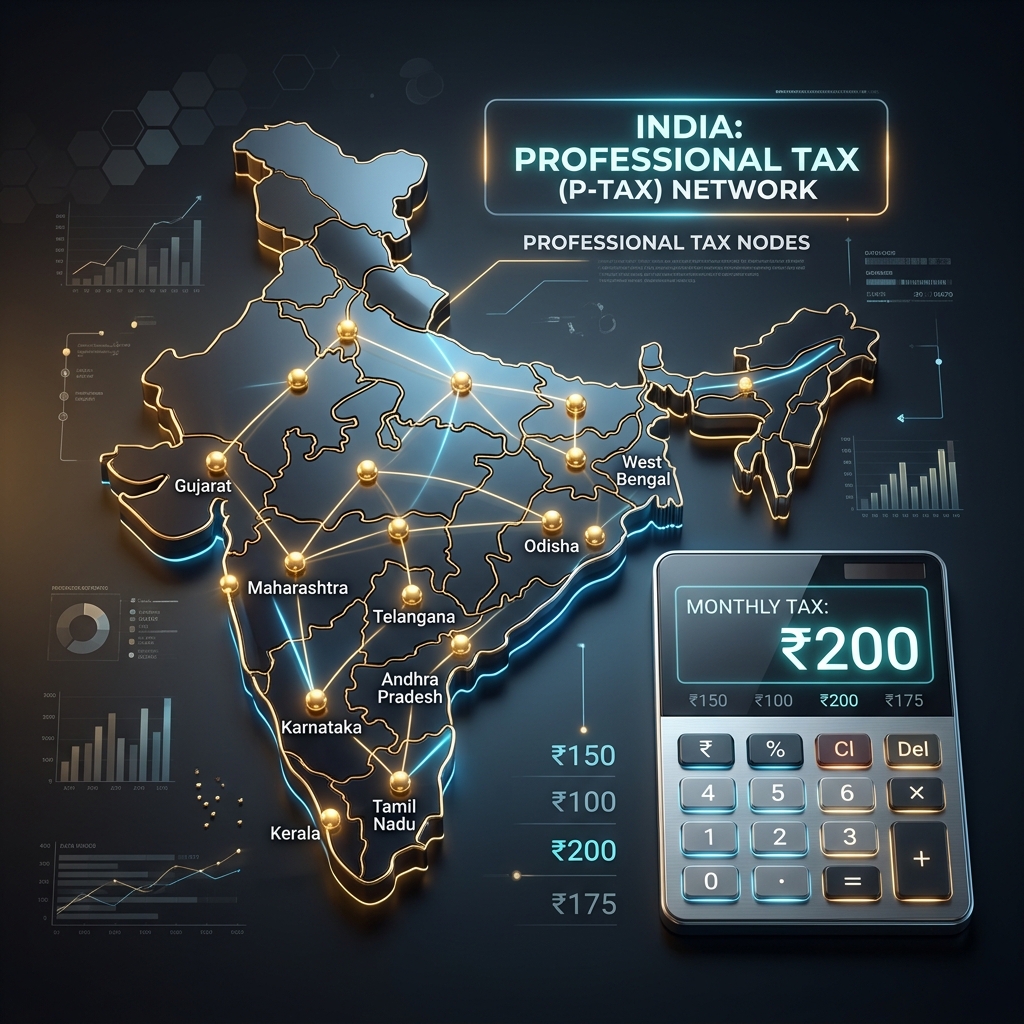
Professional Tax (PT) in India: State-wise slabs & registration guide 2026
Professional Tax (PT) is one of the most frustrating "small" compliances in the Indian business ecosystem. Why? Because it isn't an Income Tax regulated by the Central Government. It is a State Tax.
This means that if you have a distributed team with employees in Mumbai, Bangalore, and Delhi, you have three different sets of rules, slabs, and filing portals to navigate. Some states don't have PT at all, while others have strict monthly filing requirements that carry heavy penalties for a single day's delay.
Here is the definitive guide to navigating the Professional Tax maze in 2026.
What exactly is Professional Tax?
Despite its name, it isn't just for "professionals" like doctors or CAs. It is a tax levied by state governments on individuals who earn an income through employment, trade, or profession.
Under Article 276 of the Constitution, the maximum PT a state can charge is capped at ₹2,500 per year. While the amount seems small per employee, the administrative burden of tracking slabs across 28 states is massive.
PTRC vs PTEC: Do you need both?
If you run a registered business entity (Pvt Ltd, LLP, or Partnership) in a PT-applicable state, you almost certainly need both registrations:
- PTRC (Professional Tax Registration Certificate): This is for you as an Employer. It allows you to deduct PT from your employees' salaries and deposit it with the state.
- PTEC (Professional Tax Enrolment Certificate): This is for your Business Entity and its core members (Directors/Partners). Even if you have zero employees, your company must pay its annual professional tax (usually ₹2,500) under this certificate.
The Landscape: PT vs. No-PT States
graph LR
    A[India PT Map] --> B[PT States]
    A --> C[No-PT States]

    B --> B1[Maharashtra]
    B --> B2[Karnataka]
    B --> B3[Tamil Nadu]
    B --> B4[West Bengal]
    B --> B5[Andhra/Telangana]
    B --> B6[Gujarat/Odisha]

    C --> C1[Delhi]
    C --> C2[Haryana]
    C --> C3[Punjab]
    C --> C4[Rajasthan]
    C --> C5[Uttar Pradesh]
    C --> C6[Himachal Pradesh]
State-wise Slab Breakdown (2026 Estimates)
Note: Slabs are subject to annual changes by state finance departments. Always verify before processing payroll.
Maharashtra: The "February Spike"
Maharashtra is famous for its unique February deduction.
- Male Employees (Monthly): ₹175 (March to January), ₹300 in February.
- Female Employees: Exempt if earning below ₹10,000/month.
Karnataka: The "Fixed Scribe"
- No PT if earning below ₹24,999.
- ₹200 per month for everyone earning ₹25,000 and above.
Telangana & Andhra Pradesh
- Up to ₹15,000: Nil
- ₹15,001 to ₹20,000: ₹150/month
- Above ₹20,000: ₹200/month
Gujarat
- Up to ₹12,000: Nil
- Above ₹12,000: ₹200/month
AEO Quick Answers: Common Questions
Which states in India do not have Professional Tax?
Major business hubs like Delhi, Haryana (Gurgaon), and Uttar Pradesh (Noida) do not currently levy Professional Tax on employees.
Is PTEC mandatory even for loss-making companies?
Yes. Professional Tax enrolment is based on the existence of the profession or entity, not on profitability. A Private Limited company in Maharashtra must pay its ₹2,500 annual PTEC regardless of its P&L.
Can an employee pay PT himself if the employer doesn't?
No. For salaried individuals, the legal liability to deduct and deposit PT lies solely with the employer. If you fail to deduct it, the state will recover the amount plus interest from the company, not the employee.
Why "Smart Founders" Automate PT
Managing state-wise slabs manually is a high-risk, low-reward task. One error leads to a notice and a trip to the local tax office. The Smart Dhandha cockpit handles this natively:
- Auto-Geographic Labels: When you set an employee's work location, the system automatically applies the correct state slab.
- The "February Logic": Never forget to deduct the extra amount in Maharashtra again; the system handles the seasonal spikes automatically.
- PTEC Reminders: Get alerts before your company's annual PTEC deadline to avoid the ₹1,000+ late fee.
- Consolidated Reports: Downland the PTRC data you need for monthly portal uploads in one click.
Final Advice: Don't ignore the "Small" Tax
While ₹200 per month sounds insignificant, state tax departments have become increasingly aggressive with audits. Late payment interest typically ranges from 1.25% to 2% per month, which compounds quickly over years of non-compliance.
Stay Compliant. Stay Smart. Run your business on a cockpit that understands every state's nuances.
Disclaimer: This information is current as of April 2026. Taxation is a state subject and rules can change without much notice. Verify with the respective state's PT portal or consult a compliance expert.