

GST LUT for exporters (2026): file before 31 March or pay 18% IGST
TL;DR: If you export goods or services from India (including IT, design, consulting and other services billed to overseas clients), a Letter of Undertaking (LUT) in Form GST RFD-11 lets you raise export invoices at 0% IGST. It is valid for one financial year and must be re-filed before the year begins — the LUT covering FY 2026-27 was due 31 March 2026, and the one covering FY 2027-28 is due 31 March 2027. Miss it, and every export invoice must charge IGST (usually 18%), which you then claim back as a refund months later — blocking your cash.
What is an LUT, in plain English?
Exports in India are "zero-rated" — the government does not want you to bear GST on what you sell abroad. There are two ways to take that benefit:
- Pay IGST on the export invoice, then claim a refund. Your money is stuck with the government until the refund is processed.
- File an LUT and invoice at 0% IGST. No tax charged, no refund to chase. Your working capital stays with you.
An LUT is simply a declaration you file on the GST portal promising to follow the export rules. For 99% of exporters, option 2 (LUT) is the obvious choice.
Real example: A Pune software studio bills a US client $10,000/month. Without an LUT it must add 18% IGST — roughly ₹1.5 lakh a month — and then file for a refund. With an LUT filed, it invoices the client at zero GST and keeps that ₹1.5 lakh working in the business.
Who needs to file an LUT?
You should file an LUT if all of these are true:
- You have an active GSTIN (registered under regular scheme — composition dealers can't use LUT).
- You export goods or services, or supply to a SEZ unit/developer.
- You want to invoice without paying IGST upfront.
If you're a service exporter — an agency, freelancer-turned-company, SaaS, or consultancy invoicing foreign clients — this almost certainly applies to you.
The deadline that catches everyone
An LUT is valid for one financial year only (1 April → 31 March). You must file a fresh LUT before the financial year starts, or before your first export invoice of that year — whichever is earlier.
| Financial year you're exporting in | File the LUT by |
|---|---|
| FY 2025-26 | 31 March 2025 |
| FY 2026-27 | 31 March 2026 |
| FY 2027-28 | 31 March 2027 |
The trap: an LUT does not auto-renew. Founders file it once, forget it's annual, and in April discover their new invoices should have carried IGST. There's no monthly reminder from the GST portal — which is exactly the gap a compliance tracker closes.
How to file Form RFD-11 on the GST portal
Filing is free and usually takes 10 minutes. Steps (official GST portal guide):
- Log in to the GST portal → Services → User Services → Furnish Letter of Undertaking (LUT).
- Select the financial year you're filing for (e.g.
2027-28). - Tick the three self-declaration checkboxes on the RFD-11 form.
- Enter two independent witnesses (name, occupation, address).
- Sign with DSC (companies/LLPs) or EVC/OTP, and submit.
- Download the acknowledgement (ARN) — keep it for your records and share it with your CA.
Keep ready: active GSTIN and portal login, two witnesses' details, DSC of an authorised signatory (or EVC), and last year's LUT acknowledgement for reference.
What happens if you miss it?
- Every export invoice must charge IGST (typically 18%).
- You then file refund claims (Form RFD-01) to get that money back — weeks to months of delay and paperwork.
- Your working capital is locked in the meantime.
Nothing is "illegal," but you've quietly turned a zero-tax export into an 18% cash-flow problem for the whole year.
How Smart Dhandha manages your LUT for you
Most tools treat LUT as a form you file once. Smart Dhandha treats it as a recurring obligation tied to who you are. Here's the flow:
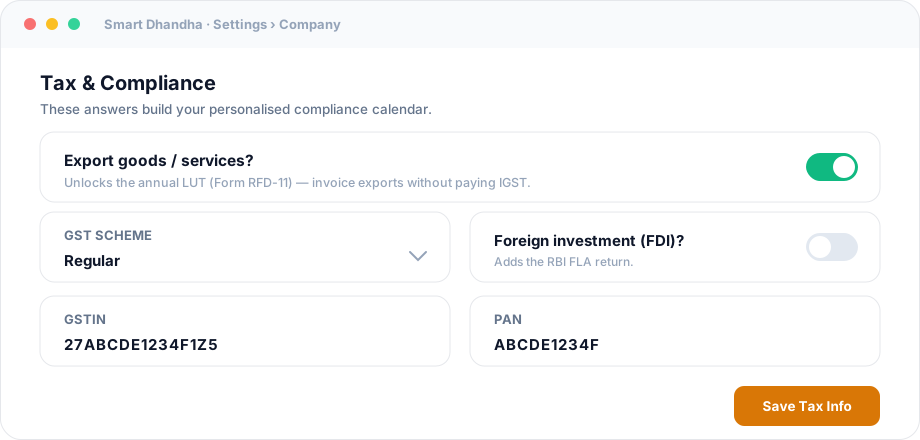
1. It knows you're an exporter. In Settings → Company, turn on "Export goods / services?". That single switch tells the system you supply zero-rated exports.
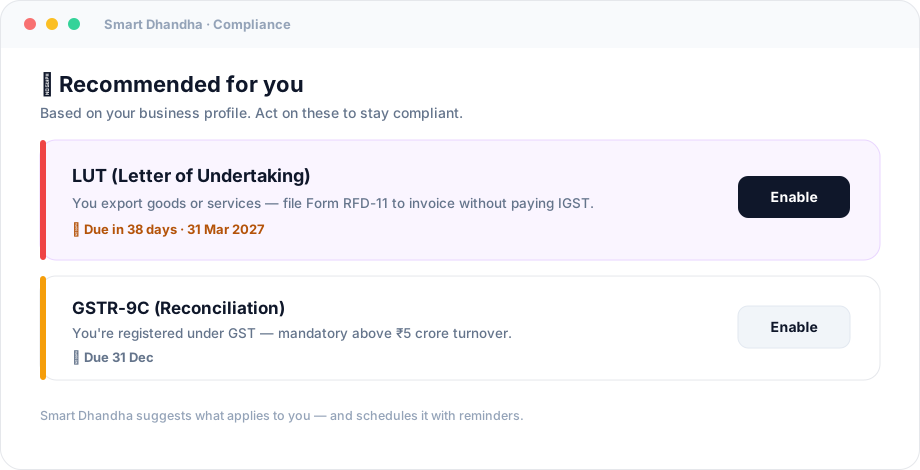
 2. It recommends the LUT — and tells you why. The moment you're marked as a GST-registered exporter, the LUT appears in "Recommended for you" on your Filings → Setup page, with the reason ("You export goods or services") and the next due date.
3. It schedules the renewal every year. Enable it once and Smart Dhandha creates the LUT filing each financial year with reminders at 45, 30, 15, 7 and 1 day before 31 March — routed by email to you and your assigned CA.
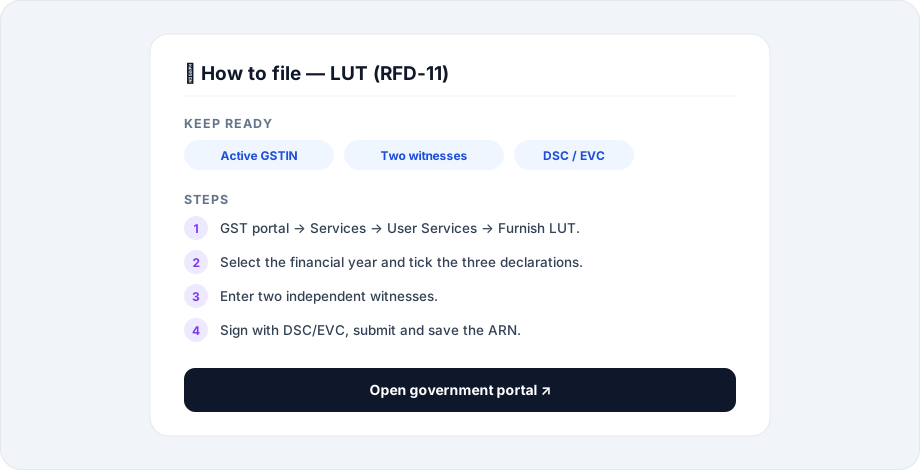
4. It shows you exactly how to file. Click the guide icon and you get the RFD-11 steps, the documents to keep ready, and a direct link to the GST portal — so you (or your CA) can act without googling around.
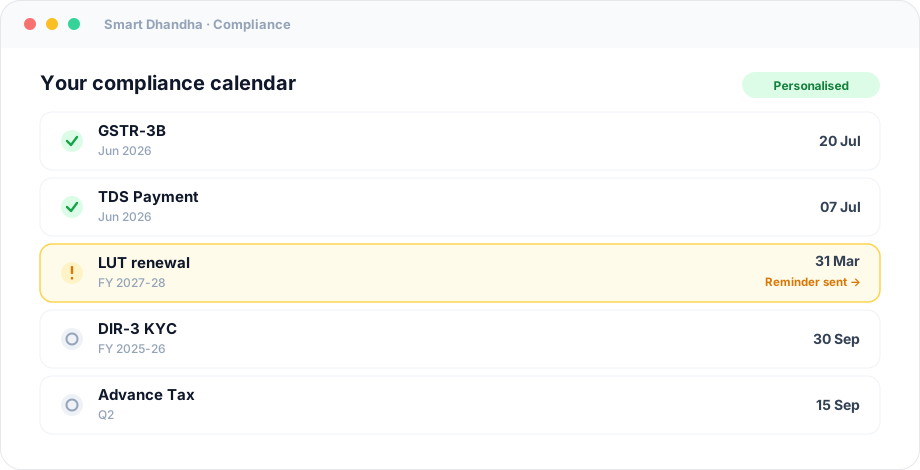
 5. It puts LUT on your calendar. Your personalised 12-month compliance calendar shows the LUT renewal in March alongside every other due date, so nothing hides until it's late.
Frequently asked questions
Is an LUT mandatory for exporters?
It's not compulsory — but the alternative is paying IGST on every export invoice and claiming a refund. For virtually all exporters, filing an LUT is the sensible choice because it keeps your cash free.
Do I need to file an LUT every year?
Yes. An LUT is valid for a single financial year (1 April–31 March) and must be re-filed before the new year begins or before your first export invoice of that year.
Can a composition-scheme dealer file an LUT?
No. The LUT (Rule 96A) route is for regular GST taxpayers making zero-rated supplies. Composition dealers file CMP-08 and GSTR-4 instead and follow different rules.
Does exporting services (not goods) count?
Yes. Export of services — IT, design, consulting, SaaS billed to overseas clients where payment is received in convertible foreign exchange — is a zero-rated supply and is exactly what the LUT is meant for.
What's the penalty for filing late?
There's no fixed late fee, but until the LUT is in place you must charge IGST on exports and recover it via refund — a cash-flow cost, not a penalty.
Stop tracking this in your head
The LUT is a small form with an expensive failure mode. If you're a founder exporting services, the answer isn't to "remember better" — it's to let a system remember for you.
Smart Dhandha tracks your LUT, GST returns, TDS, ROC filings and more from one place, personalised to your business. Set up your compliance profile free →
This guide is for general information and reflects rules as of July 2026. GST provisions change — confirm your specific case with your CA or the GST portal. Sources: GST portal — furnishing LUT, ClearTax — LUT in GST.